Moving a heated market debate beyond dollars
Could the BTC-gold multiple be a reliable market signal? Here are the facts, the math, and the caveats.


- Below is the latest edition of w3w, my free newsletter about emerging technology, including AI, Bitcoin, Ethereum, and more . If you would like to receive it in your inbox every Sunday, please subscribe here.
There is an ongoing, sometimes heated nerdfight between bitcoiners and gold bugs. For anyone blissfully unaware of this, as sane people generally are, some background:
Fans of each asset dispute whose preferred form of money is more fit to replace the mutually detested U.S. dollar as a store of value and a global financial standard. Bitcoin lays claim to being both limited in supply and digitally native, thus arguably more relevant to a modern, internet-driven economy. By contrast, gold's scarcity stems from its physical tangibility. Plus it has a much longer track record as a monetary asset, going back hundreds of years.
If you spend any time whatsoever talking to bitcoiners and gold bugs, as I have for more than two decades, it also quickly becomes noticeable that the two sides' criticism of the dollar is exactly the same: It's printed ad infinitum by Uncle Sam, thus inevitably devalued over time.
Yet in the mainstream press and on social media alike, we tend to discuss gold and bitcoin in terms of their dollar-denominated prices. What if we were to mathematically compare them directly to one another? Take the figurative and literal common denominator out of the mix and really get down to brass tacks.
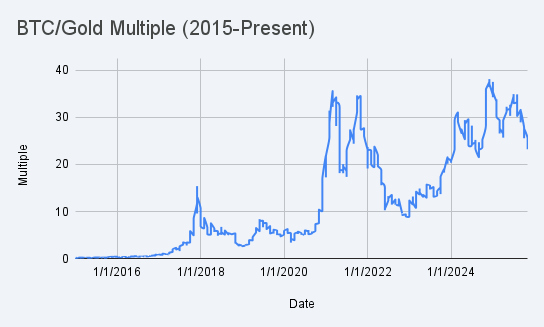
In that spirit, I've been crunching some historical data on the multiple of bitcoin's USD price to that of gold per ounce, based on weekly closes going back to 2010.
Some factoids I've noticed so far, along with other recent bitcoin-related news of note:
- The all-time high in the bitcoin-gold multiple was set in December 2024, when one bitcoin bought 38 ounces of gold. It has since retreated to 23.2 ounces, as of last week. That's a 14-month low.
- In bitcoin's early history, following publication of Satoshi Nakamoto's whitepaper in 2008, bitcoin traded for a long time at a fraction of gold's price per ounce. Their weekly closes first reached parity in February 2017, when both traded above $1,200. Then the multiple fluctuated above and below parity for a little while until April 2017. It's consistently stayed above 1.0 ever since.
- The first time the bitcoin-gold multiple posted a weekly finish above 20 was in January 2021.
- Since that milestone, the multiple's long-term low is 8.98. That low was set in January 2023, during the throes of the crypto market's post-FTX collapse.
- In dollar terms, bitcoin has been flagging lately as traders have unwound riskier market bets due to concerns about the U.S. economy. The token dipped below $100,000 last week for the first time since May.
- On a more promising note, the Czech Republic's central bank just bought $1 million in bitcoin, becoming first global central bank to hold the token. By contrast, there is a looooooong history of central banks owning gold. If bitcoin can continue to elbow its way into this category of demand, that would be a very positive development for the token over the long haul.
Of course, the burning question lurking between the lines above is what value the bitcoin-gold multiple might hold as a market signal for investors. I honestly don't know the answer right now; I'm curious to do more analysis and have other sets of eyes take a look at the data as well.
That said, a high multiple should imply that gold is relatively weak, and a low multiple should mean bitcoin is weak. If you apply that standard as a set of buying signals, the couple of long-term lows and highs I mentioned above would've worked very well in retrospect.
For example, if you had bought bitcoin at 2023's post-FTX low in the multiple, you would've made a 459% return to date. And if you had bought gold at the all-time high multiple in December 2024, that would've returned 53%.
Hmmmm...
Week in Review: Nov. 9-15, 2025
- Yikes. Anthropic said it discovered an AI-generated cyberattack from China targeting at least 30 organizations. This marks the first documented case of a large-scale cyberattack executed without substantial human input. (TechRadar)
- Ripple said it has raised $500 million in a new venture investment round that values the company at $40 billion in full. The company, whose XRP token is currently the world's fourth-largest by market capitalization, has been pushing into new lines of business recently, including crypto custody and prime brokerage. (CNBC)
- Renowned shortseller Jim Chanos said he has unwound what appears to be a highly profitable bearish bet on Strategy, spurred by his skepticism that its shares were trading at too high a premium to its bitcoin holdings. The move comes at a time when Wall Street has generally grown wary of so-called crypto treasury companies. (Financial Times)
- OpenAI asked a federal judge in New York to reverse a recent court order to turn over 20 million anonymized ChatGPT chat logs in a copyright infringement lawsuit brought by the New York Times and other news outlets, citing concerns that it would expose users' private conversations. (Reuters)
- Microsoft's vague public disclosures regarding its financial relationship with OpenAI are making Wall Street Journal accounting reporter Jonathan Weil's head hurt. That's my educated guess, at least, speaking as Jon's former cubicle mate after reading his latest, characteristically thorough story on the topic. 😂
Market Snapshot
A quick look at some major indicators as of Friday's close on Wall Street:
| Indicator | Close | Weekly | YTD |
|---|---|---|---|
| Bitcoin | $94,789.99 | -8.6% | +1.0% |
| Gold | $4,084.40 | +1.9% | +55.3% |
| USD Index | 99.27 | -0.3% | -8.5% |
| 10-yr U.S. Treasury Yield |
4.148% | +0.055 | -0.425 |
| Nasdaq 100 | 25,008.24 | -0.2% | +19.0% |
| MSCI All-Country World Index (ex US) |
1,085.67 | +1.3% | +29.5% |
Looking Ahead
- The Senate Agriculture Committee released its initial draft of a bill to broadly restructure regulation of crypto markets in the U.S. The draft, which follows a comprehensive stablecoin law passed earlier this year, seeks to clarify the roles of different federal agencies in overseeing crypto trading. It also would create new rules to mitigate conflicts of interest in the industry. (CoinGeek)
- Apple will pay Google approximately $1 billion a year to access the search giant’s AI technology to power its Siri voice assistant. The deal highlights Apple's lag in developing AI tools of its own compared to other Silicon Valley hegemons. (CNET)
- Moonshot AI, a Beijing-based startup, says its K2 language model outperformed both OpenAI's GPT-5 and Anthropic's Claude Sonnet 4.5 in early testing entailing complex, multi-step reasoning tasks. The announcement underscores China's growing competition with America's major AI players. (VentureBeat)
Odds & Ends
- "Moonlighting" is so 1988. The modern term you're looking for is "polyworking," says the AP's Cathy Bussewitz.
- Good to know! Researchers at the University of British Columbia have published a study claiming to have mathematically proven that the universe is real, not a simulation. (Popular Mechanics)
That's it for now. Thanks for reading the newsletter today! If you want to know more about w3w's history and (ahem) the author, that info is available here.
Please note, I regularly use several AI apps to assist production of w3w. But the final edit is 100% by me. For fuller detail, see the newsletter's commit history on GitHub.
If you need to reach me directly, please email peter[at]w3w[dot]media.
Best wishes for a healthy and productive week ahead.